

The Performance Engine: Why Talent Alone Is Never Enough
Why the most capable people get passed over and the three-layer framework that explains almost every career that's stalled - Signal Forward Series Article

A Signal Forward Article
Signal Forward is a series inside The Ready Set: same publication, different altitude. The Ready Set is for leaders. Signal Forward is for everyone else: the individual contributors, specialists, and practitioners whose behavioral patterns determine whether their contribution gets seen, valued, and rewarded, regardless of title or tenure.
New here? Start with the first article. In People or HR? Pass this along to your team.
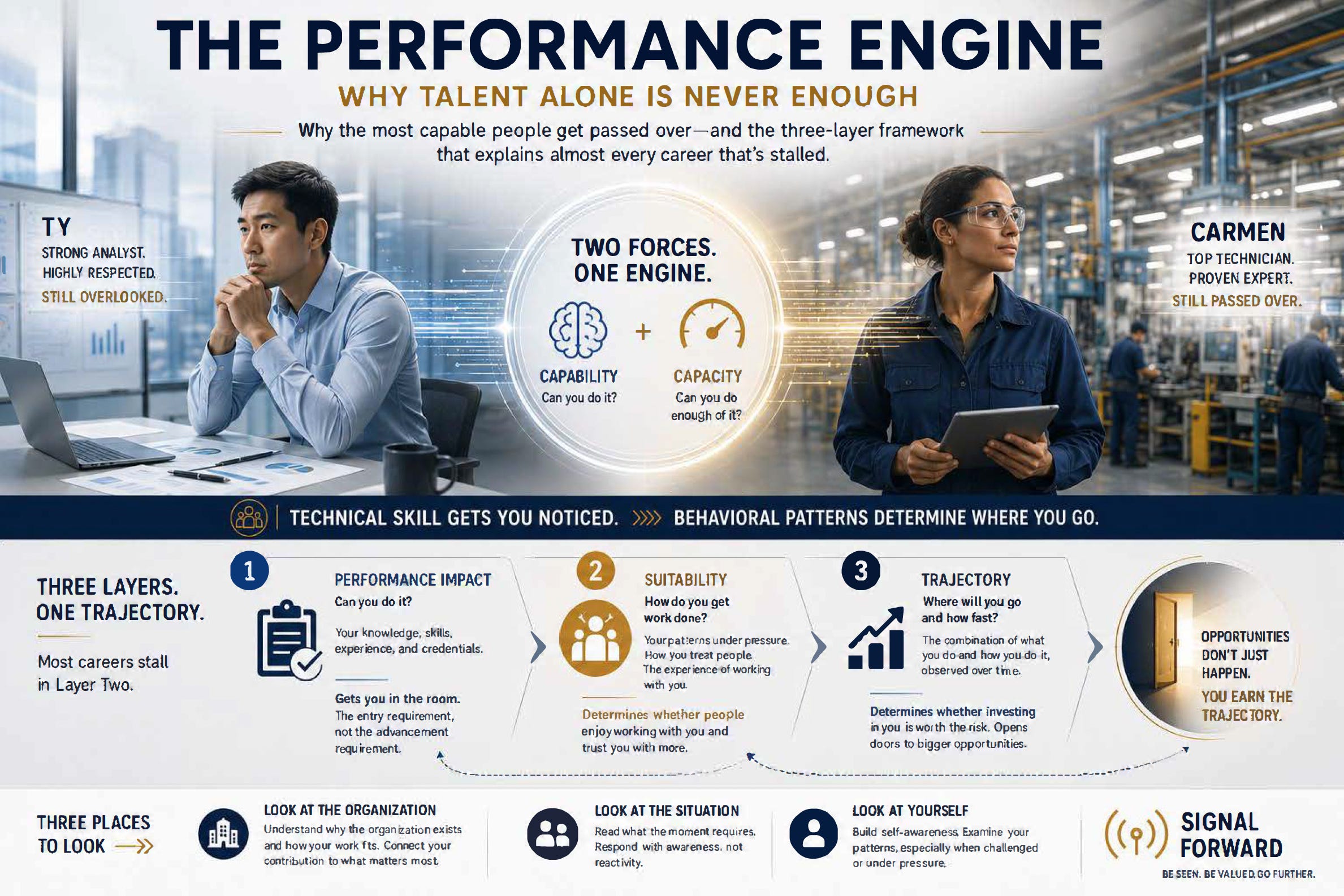
Ty was the strongest analyst in his department. Everyone knew it. His models were precise, his insights respected, and when a complex analysis was needed, his name came first. Four years in the role. Four years watching less technically skilled peers move into senior positions while he stayed put.
Six hundred miles away, in a manufacturing plant outside Memphis, a maintenance technician named Carmen was having the same experience in a completely different world. Carmen was the best troubleshooter on her shift. When a production line went down, she could diagnose the problem faster than anyone. She’d been passed over twice for the lead technician role, both times for people who, in her view, didn’t know the equipment as well as she did.
Ty worked in a glass office. Carmen worked on a concrete floor. But the force holding both of them in place was identical: they were both exceptional at the technical part of their jobs and completely unaware of the behavioral patterns that were quietly limiting everything else.
This is the story most high performers never get told. And it’s the story this article is about.
What Ty Couldn’t See
When Ty asked his director about advancement, the feedback was vague. Keep doing what you’re doing. You’re valued. What nobody told him directly was that his skill had never been the question.
The question was whether people wanted to work with him when the pressure was on.
The answer, formed over four years of accumulated behavioral evidence, was: Ty is brilliant but brittle. He pushes back on feedback. He gets visibly frustrated when timelines compress. He solves problems but creates tension doing it. People respected his output, but they did not enjoy his process.
What Carmen Couldn’t See
Carmen’s supervisor gave similar non-answers when she asked about the lead role. You’re one of our best. Just keep at it. What nobody told her directly was that the lead role wasn’t just about technical diagnosis. It was about coordinating a crew during a crisis, staying calm when a line was down and the production manager was calling every ten minutes, and communicating with operators who didn’t understand the mechanical side.
Carmen was fast and brilliant under pressure. She was also sharp-tongued when stressed. When a line went down and an operator gave her incomplete information, her instinct was to let them know it. If you’d told me the bearing was making noise yesterday instead of waiting until it seized, we wouldn’t be standing here right now.
She was usually right. And it didn’t matter. Because the operators started working around her instead of with her. They’d call another technician first, even one who was slower, because the experience of working with Carmen during a crisis was unpredictable.
Both Ty and Carmen were stuck. Both for the same reason. And neither one knew it.
Two Forces, One Engine
Every career, whether it plays out in a conference room or on a production floor, runs on two forces.
Capability: Can you do it?
Can you perform the work? Do you have the skills, knowledge, and experience to deliver what the role requires?
But here’s where most people stop thinking about capability too early. Capability isn’t just the technical part. An analyst who builds a brilliant model but can’t present it to a skeptical audience without getting defensive has a capability gap. A technician who can diagnose any failure but can’t communicate what happened without alienating the crew has a capability gap. The technical skill is strong. The professional capability, the full range of what the role actually requires, is incomplete.
And capability doesn’t stand still. Ty’s skills were built for a world where the analysis was the deliverable. Carmen’s were built for a world where fixing the machine was the whole job. Both worlds were shifting. The capability that got them here wouldn’t get them where they wanted to go.
Capacity: Can you do enough of it?
Picture Ty with one project: brilliant. With three simultaneous projects, two with shifting timelines and a difficult stakeholder: unknown, because he’d never been tested there, and his behavioral signal suggested the pressure would crack him.
Picture Carmen on a normal Tuesday, troubleshooting one issue: flawless. Now picture a Friday night when two lines go down at once, the parts supplier is closed, the shift supervisor is new, and the production manager wants an ETA every ten minutes. Carmen’s technical skill is the same. Her capacity to deliver that skill under multiplied pressure, while coordinating others, while communicating clearly, while managing her own frustration, that’s the question the lead role was designed to answer.
Capability without capacity produces potential that never scales. The senior role requires both.
The Three Layers That Actually Determine Your Trajectory
Here’s where it gets specific. Because most people think about career advancement as a single question: Am I good enough? But the organizations you work in are actually asking three distinct questions, in sequence, whether they know it or not.
Layer One: Performance Impact
Your knowledge, skills, experience, and credentials. The resume version of you. Ty’s impact was never the issue. Carmen’s troubleshooting record was the best on her team. If performance impact were the only thing that mattered, both would have been promoted years ago.
Performance Impact gets you in the room. On the floor, it gets you the call when something breaks. But rooms and shop floors are full of highly eligible people whose careers have stalled. Your impact is the entry requirement, not the advancement requirement. And most high performers already have it. Which means performance impact is rarely the actual problem.
Layer Two: Suitability
This is how you get work done. Your patterns under pressure. Your tendencies when challenged. How you treat people when things go wrong. Whether the experience of working with you during difficulty is something people want to repeat.
Here’s a quick test. Think of two people you’ve worked with who had similar skills. One was someone you wanted on every project or every crew. The other was capable but exhausting. Both were had impact. Only one was suitable for the high-trust work that accelerates careers.
Ty’s suitability blind spot was defensiveness disguised as intellectual rigor. Carmen’s was sharpness disguised as straight talk. In both cases, the person experienced their own behavior as a strength. The people around them experienced it as a cost.
That gap, between how you experience your own behavior and how others experience it, is where careers stall.
Layer Three: Trajectory
The combination of what you do and how you do it, observed over time. Not something you declare. Something others conclude. It answers the question that determines where you go and how fast you get there: Given everything I’ve seen from this person, is investing in them worth the risk?
Ty believed his trajectory was high because his output was strong. Carmen believed hers was high because nobody could match her on the equipment. Both were right about the performance impact part and blind to the suitability part. And trajectory impact, the thing that actually opens doors, requires both.
Performance Impact gets you in the room. Suitability determines whether people enjoy working with you, relate to you, and how you influence them. Trajectory determines whether the next opportunity is bigger than the last one. Whether you work in an office or on a floor, that sequence is identical.
The Blind Spot Nobody Warns You About
There’s a specific trap that catches talented people more than anyone else: the belief that doing your job exceptionally well is sufficient.
It isn’t. And this isn’t cynical, it’s structural.
The next level of almost any role isn’t a bigger version of what you’re currently doing. It’s a different kind of contribution entirely. Ty’s next level wasn’t better analysis. It was the ability to navigate organizational dynamics, communicate under pressure, and bring people along when they pushed back. Carmen’s next level wasn’t faster diagnosis. It was coordinating a crew through a crisis without leaving people feeling diminished in the process.
Nobody told either of them this directly. And that’s the problem. The feedback systems in most organizations are terrible at surfacing suitability gaps. Managers say keep doing what you’re doing when what they mean is your technical work is fine but working with you is hard and I don’t know how to say that. So talented people keep doing what they’re doing, keep getting passed over, and keep assuming the system is broken.
Sometimes the system is broken. But more often, the signal is the problem…and the signal is fixable.
Three Places to Look
If you recognize any version of Ty or Carmen in yourself, here’s where to start.
Look at the organization. How connected are you to why the organization exists and how your work fits? Dani, a supply chain coordinator, spent two years managing metrics without understanding what they meant to the people above her. When she learned how her numbers translated into the VP’s cost report, everything changed. Not her skills, but her understanding of where her contribution actually landed. Carmen had a parallel moment. She’d always thought of her job as keeping machines running. When she sat in on a production planning meeting for the first time, she realized that every hour of downtime she prevented was worth roughly twelve thousand dollars in output. She wasn’t a mechanic. She was a frontline contributor to the plant’s profitability. That realization changed how she prioritized, communicated, and framed her own value.
Look at the situation. Each of us responds differently when things go well versus when they go badly. Ty read a stakeholder’s challenge as a personal attack and matched the energy. Carmen read an operator’s incomplete information as negligence and let them know it. Both were reacting to what the situation felt like rather than reading what the situation actually needed. Situational awareness is asking, in real time: what does this moment require from me? Not what does my instinct want to do, what does the moment need?
Look at yourself. Think of the last time you received genuine criticism. What happened in your body? What did you want to say? What did you actually say? Ty’s self-awareness stopped at his technical strengths. Carmen’s stopped at her diagnostic speed. In both cases, the behavioral patterns they couldn’t see were the ones holding them back.
The blind spot isn’t that you don’t know your strengths. Most high performers know their strengths well. The blind spot is that the thing you experience as a strength, the directness, the rigor, the high standards, is sometimes the exact thing creating friction in the people around you.
What This Means for You
Your performance engine runs on capability and capacity. But what actually determines your trajectory is whether you’re eligible, suitable, and impactful. In that order, and all three together.
Most individual contributors spend the majority of their development energy on performance impact: more skills, more certifications, more technical excellence. And that energy is never wasted. But if you’re already technically strong and your career still isn’t moving, the impact is probably not the gap.
The gap is almost always suitability. How people experience working with you. How you show up under pressure. Whether the behavioral evidence you’re creating every day predicts that investing in you is worth the risk.
Ty and Carmen both figured this out eventually. Ty stopped treating feedback as an attack and started treating it as information. Carmen started asking what the situation needed from her before reacting to what the situation felt like. Neither change was dramatic. Both were consequential. The behavioral evidence they started creating was different, and the signal it sent was different.
The career didn’t change. The performance engine did.
What about you? If you’re honest about where you might have a gap, performance impact, suitability, or trajectory, which layer is it? You don’t have to answer that publicly. But it’s worth sitting with. I’d love to hear what comes up in the comments.
Subscribe to The Ready Set
By Ryan Carnes | A data-backed development experience
Providing executive caliber leadership and talent content and resources to everyone. Subscribe free and get new behavioral-based leader and talent insights every week.
Plus two Ready Set resources to put to work immediately.
most performance systems measure layer 1. they promote people into a level where layer 2 and 3 are what matter.